Not therapy or diagnosis. You can always simply note one thing that is present and return to what you were doing.
An emotion is not a single block
Someone important hasn't replied to a message. We check the phone, feel anxious, then irritated. Yet within that same moment there may be fear of loss, uncertainty, a need for reassurance, a force that wants to hold on, and a force that wants reality to be different.
ARC does not oblige us to find a final explanation. It is a scaffold: enough structure to see clearly, but not so much that life turns into a psychological analysis.
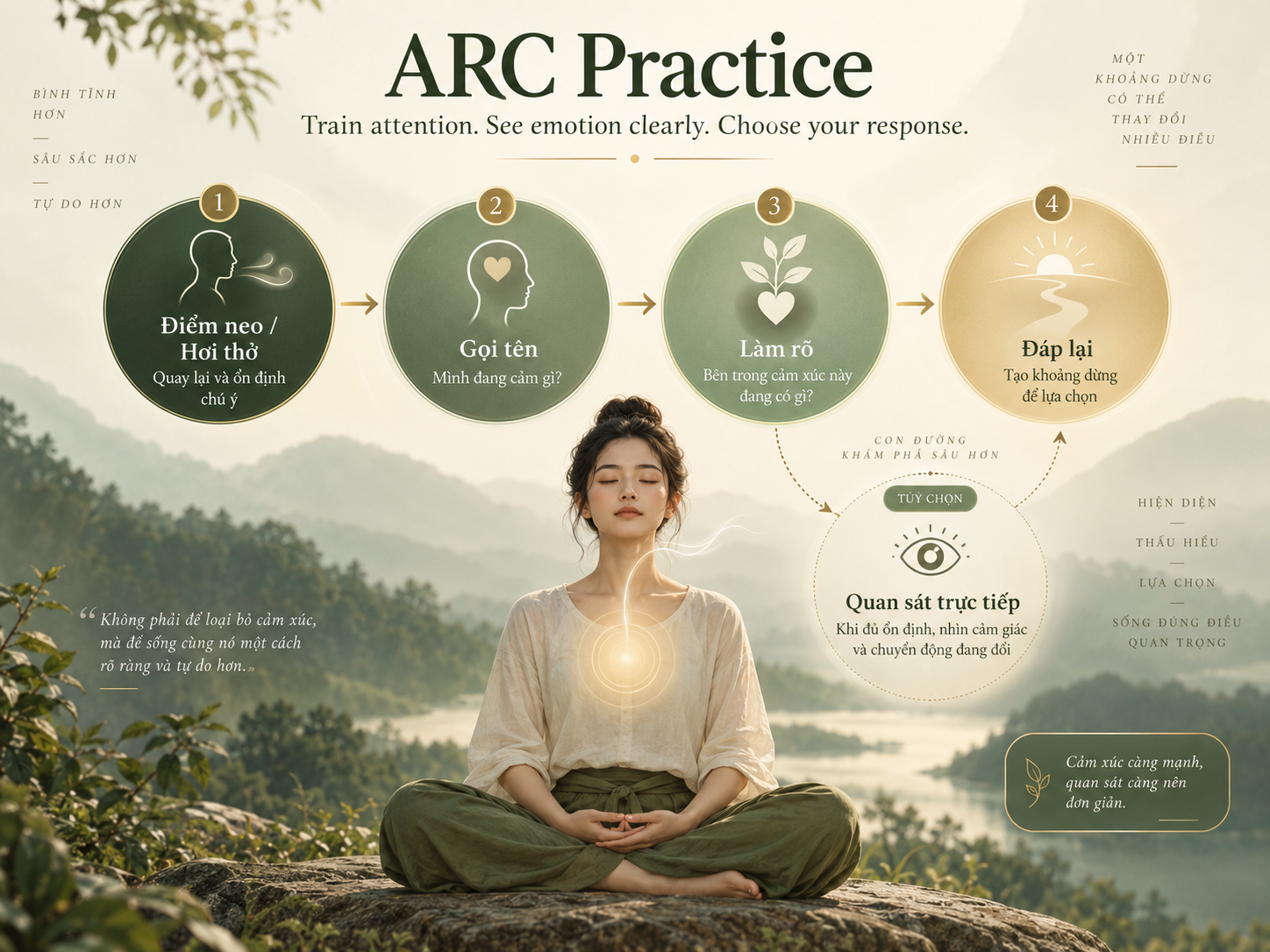
- Name it. “There is anxiety.” The emotion is present, but it is not the whole of who you are.
- Clarify just enough. There may be uncertainty, fear of loss, a need for reassurance, and a force that wants to control, all at once.
- Respond. Create a pause so you can act appropriately within your capacity — or not act yet.
Looking directly is an optional branch, not a mandatory next step. When attention is steady enough and this way of observing is useful, you can set interpretation aside for a moment to notice the felt tone, the direction of the reaction, and the change. You need not pass through naming or clarifying first.
Learn to name.
Learn to deconstruct.
Learn to observe.
The anchor lets you train the ability to return. Emotion is the domain in which we train ourselves to see more clearly — and then, gradually, we no longer need to build a story around everything that happens.
The stronger it is, the less you should probe
The higher the activation, the lower the resolution. Before choosing a mode, check in with yourself in a practical way — not as a medical measure or a label about your nervous system. If you are unsure, choose the more cautious zone.
- Red zone · high activation. Only recognise and stabilise: a brief naming, stop the reaction, gentle grounding.
- Yellow zone · settling. Understand just enough: look at a few Components or Story while still steady enough; a Shadow check only when it helps.
- Green zone · relatively steady. More options are available: clarify further, or try looking directly if you are already used to this way of observing. Green zone does not automatically mean you must practise deeply.
Grounding in the Red zone can be simple: put your feet on the floor, name a few objects around you, drink some water, move to a safer place if you can, or reach out to an appropriate support person.
Attention. Resolution. Choice.
ARC is a memory landmark, not a checklist. Attention is returning to attention through the breath or another safe anchor; Resolution is seeing the emotion clearly enough; Choice is the pause before responding.
A short practice
Level 1 — Recognize
Begin with whatever is nearest: there is joy, there is sadness, there is anger, there is fear, there is anxiety, there is shame, there is jealousy, there is tenderness/pity, there is disappointment, there is helplessness, or there is calm/peace. The labels are an entry point, not boxes; choose at most three labels, or note “not yet clear”.
STOP → NAME → ALLOW
Pause for a few beats before you text, speak, or decide. Name it lightly: “There is anger”, rather than “I am an angry person”. There is no need to deal with it right away.
Level 2 — Deconstruct
If this recurs, try to see how the mind is reading the situation, what matters, and how the mind is trying to cope: there may be something threatened, something that could be lost, uncertainty, comparison, expectation, recognition, connection, a sense of agency, care, a need to hold on, experiential avoidance, or a control agenda. An emotion is not necessarily a single block.
Optional Shadow check: Does the thing I judge in the other person exist, in some form, in me? What self-image am I trying to protect? Is there a need or a part of me I have not yet allowed to be acknowledged?
Insight branch — Looking directly
This is a separate option, not a mandatory Level 3 after clarifying. If you set the story down for a moment, what remains? Observe the felt tone (pleasant, unpleasant, or neutral) together with the prominent direction of the reaction (holding, pushing away, changing, or moving toward). This is a minimal way of seeing movement, not the “final essence” of the emotion. If it is not clear, it is enough to know “not yet clear”.
Bringing awareness back into life
After seeing just enough, distinguish what still lies within your influence, choose a small step that is kind, responsible, and feasible, then do not keep using the observation to force another person or an outcome to change immediately. ARC stops here: it does not directly repair belief, identity, or motivation.
“Emotion is not an enemy to be eliminated. It is a process that can be recognised, resolved, and observed.”
Foreword — Why do we need a framework at all?
Many people come to practice because of something very ordinary: they anger easily, worry too much, react too fast, repeat the same conflict, or cannot understand why a small thing tires them out for a whole day.
What they need first is usually not a lofty philosophy. They need a pause. Instead of moving straight from “He made me angry” to a wounding remark, a hasty message, or hours of self-blame, a small moment can appear:
“There is anger.”
The event does not vanish. The anger may still be strong. But the experience begins to change structure: the anger is no longer entirely who I am, no longer the final truth, no longer a command to act at once.
ARC does not teach you how to become a person without emotion. It does not promise healing, an end to suffering, or a spiritual attainment. It does something more modest:
It helps us see experience at the right resolution, at the moment it is needed.
1. The problem is not only the emotion
Trying to eliminate the emotion
When we are angry, we want the anger gone. When we worry, we want the worry gone. When we are sad, we want to feel steady again quickly. This is very natural, but sometimes it adds another layer of tension:
There is an uncomfortable emotion
→ we resist having the emotion
→ the experience grows heavier.
ARC does not open with “How do I make it stop?” It opens with: “What is present?”
Analysing everything
The opposite mistake is to turn every emotion into a case to scrutinise. We dissect the mind continually, fix the mind continually, and then grow weary of the very work of observing. That can easily become hyper-monitoring.
Observe earlier, with less effort.
Not observing more. Recognising earlier, with less effort.
2. Three layers — from emotion to process
Level 1 — Recognize
What emotion is present?
The language here can be very plain: there is joy, there is sadness, there is anger, there is fear, there is anxiety, there is shame, there is tenderness/pity, there is disappointment, there is peace.
Taxonomy v0.2 — 24 Level 1 labels in 6 groups
| Group | Suggested labels |
|---|---|
| Self & sense of agency | shame, guilt, helplessness, despair |
| Loss & connection | sadness, loneliness, regret, jealousy |
| Threat, desire & expectation | fear, anxiety, craving, disappointment |
| Resistance & standing | anger, irritation, disgust, wounded pride |
| Comparison & care | envy, tenderness/pity, gratitude, love |
| Opening & settling | joy, interest, equanimity, peace |
These are everyday emotion labels, not bodily sensations or the three kinds of Thọ (feeling-tone). “Not yet clear / hard to name” is always valid.
STOP → NAME → ALLOW. Pause for a few beats. Name it lightly: “There is anger.” There is no need to deal with it right away. The goal is not to name it perfectly accurately; the goal is to create the first distance: the emotion is happening, and it is not the whole of me.
Level 2 — Deconstruct
What is the mind reading, what does it value, and how is it trying to cope?
A label such as “anger” may come with threat, a need for recognition, experiential avoidance, or a control agenda. Level 2 does not look for a single cause. It helps us see the emotion as many processes converging. On a deeper map, Components are called Psychological Structure: Appraisal → Need/Value → Strategy, with Pattern/Belief when useful.
Taxonomy v0.3 — 12 core Components across three layers
| Component | Felt question |
|---|---|
| Threat | Is there something that could cause harm or touch a boundary? |
| Loss | Is there something important that has, or could, disappear? |
| Uncertainty | Is there something unknown keeping the mind on guard? |
| Comparison | Am I positioning my worth alongside someone else's? |
| Expectation | Is there a model of how reality “should” unfold? |
| Recognition | Is there a need to be seen, understood, or affirmed in worth? |
| Belonging / connection | Is there a need to be close, or not to be excluded? |
| Agency | Does being able to do something in this situation matter to me? |
| Care | Is there a wish to reduce suffering or do good for someone? |
| Need to hold on | Is there something whose possible loss I find very hard to accept? |
| Experiential avoidance | What experience, situation, or sensation am I trying to avoid? |
| Control agenda | What do I believe must change before I can be okay? |
No label is a diagnosis, a final cause, or evidence of motive. “Not yet clear / not applicable” is always kept available.
Bridge from Level 2 → Level 3: meaning is not the Atom
Level 2 helps us try to understand structure; Level 3 observes movement in the moment. There is no one-to-one translation between them. Clinging may go together with a pleasant feeling-tone + holding when something precious is present, or with an unpleasant feeling-tone + holding when there is a risk of loss. Conversely, recognition, comparison, agency, and expectation sometimes settle together into an unpleasant feeling-tone + wanting to change.
These are possibilities to test, not laws. When moving into Level 3, set the explanation aside for a moment and ask: “What Thọ (feeling-tone) is here?” “How is the mind moving?”
Before the Shadow check, an optional Pattern Check can ask: “Is this familiar?” or “Is there a must/always/never sentence running?” Only open the question about the belief or expectation behind it if that genuinely helps.
Level 3 — Observe Atom
Right up against this moment, what feeling-tone is there, and in what direction is the mind moving?
ARC uses the working hypothesis Atom = Vedanā × Vector: Thọ (feeling-tone) can be pleasant, unpleasant, or neutral; Vector can be holding, pushing away, changing, or moving toward. The Atom is ARC's minimal unit of observation, not the “final essence” of the emotion. In a single check-in, choose one prominent Vector; an episode may contain several Atoms in sequence or interwoven.
Unpleasant feeling-tone.
There is a force that wants to push away.
Then this force changes.
If experience does not fit this taxonomy, “not yet clear” is a valid observation. We revise the model; we do not force experience into the model.
3. The mechanism — from event to action
The two diagrams below are educational tools, not a claim that every experience always follows a straight line.
For example, when someone contradicts your view, there may be a sentence that was heard, discomfort in the body, an urge to argue back, the story “they are looking down on me”, a self-image that needs protecting, anger, and then a retort ready to burst out.
ARC does not say that story is certainly wrong, or that the other person is certainly blameless. It creates conditions for asking:
What part is event?
What part is interpretation?
What part is feeling-tone and the force of the reaction?
What do I want to do next?
Seeing this chain does not deprive us of the capacity to act. It gives us one more chance to act without being dragged along by the whole chain.
4. Observation Budget — use just enough depth
Not every experience needs Level 3. Before choosing a mode, ARC uses a safety rail:
The higher the activation, the lower the observation resolution.
This is a self check-in heuristic, not a medical measure or a label about your nervous system. When unsure, choose the more cautious zone. Do not use insight practice to override a state of overwhelm.
| Zone | When you may be in this zone | Practice |
|---|---|---|
| Red high activation | the emotion is very strong, the mind is tangled, there is an urge to react at once, it is hard to hold attention on a simple sentence | Level 1: a brief naming, stop the reaction, gentle grounding; do not unpack Components or Atom. |
| Yellow settling | emotion is still present but you can pause, recall the situation, and answer an open question | Level 2: choose a few Components/Story; Shadow check only when it helps. |
| Green relatively steady | attention is steady enough to notice tone and the direction of the reaction, and you can also pause | Level 3: feeling-tone → Vector → arising / changing / passing. |
Grounding in the Red zone can be simple: put your feet on the floor, name a few objects around you, drink some water, move to a safer place if you can, or reach out to an appropriate support person. In immediate danger, crisis, abuse, thoughts of self-harm, or a sense of being unsafe: do not contemplate deeply; prioritise appropriate support.
After this safety rail, ARC uses three modes:
| Mode | When to use | What to practise |
|---|---|---|
| Light | Red zone, a mild/passing emotion, or when you need to reduce depth | A brief noting, stop the reaction, then return to the present |
| Reflect | Yellow zone: something recurring/distressing, settled enough to observe | Unpack a few Components and Story |
| Insight | Green zone: a deep pattern; the mind is relatively steady | Observe feeling-tone × Vector and the change |
Only use high resolution when the expected value of the insight is greater than the energy it will cost.
A mild emotion can be let go. Only a recurring pattern needs reflecting on. Only a deep pattern is a candidate for Insight. Mature practice does not make the number of steps grow forever:
Beginner: emotion → analyse → understand → let go.
Familiar: emotion → recognise the pattern → let go.
Deeper: feeling-tone → know → do not cling → change.
5. Two axes — Jung and Vipassanā do two different things
Vertical axis: the depth of the process
This axis asks: “How is this being constituted and how is it changing?” This is where we observe feeling-tone, Vector, and arising–changing–passing.
Horizontal axis: psychological meaning
In Reflect mode, a Shadow check inspired by Jung can ask: “Why does this theme carry such strong energy for me?” It is only an open invitation, not a diagnosis of projection.
- Does the thing I judge in the other person exist, in some form, in me?
- What self-image am I protecting?
- Is there a need I have not yet allowed to be acknowledged?
The working sequence is Denial → Ownership → Integration → Observation → Non-identification. Ownership means not placing the entire cause outside oneself. Non-identification means not turning psychological content into a fixed label about who I am.
6. From utility to insight
Beginners usually do not come because they want to discuss vô thường (impermanence) or vô ngã (non-self). They come because they want less anger, less worry, better relationships, or to stop doing what they will regret. ARC respects that starting point.
Stage 1 — Utility
“Recognise the anger so I don't say something I'll regret.”
Stage 2 — Self-understanding
“What might this anger be protecting?”
Stage 3 — Direct observation
“There is an unpleasant feeling-tone. There is a force that wants to push away. There is change.”
When practitioners directly see that experience does not stand still, they can discover for themselves: what in this process is fixed? What happens when I resist the feeling-tone? Is there really an unchanging subject steering each moment?
Do not teach Emptiness as a conclusion. Help the learner see clearly enough that they can observe for themselves the non-fixed and dependent nature of phenomena.
So ARC is a scaffold oriented toward Vipassanā, not a simplification of, or substitute for, Vipassanā.
7. A full example — someone I love is in pain
Suppose the person you love is ill. You feel tenderness, worry, and discomfort at being unable to make them well right away.
Level 1
There is love.
There is worry.
There is helplessness.
Level 2
There may co-exist a wish for them to suffer less, a wish to care for them, a wish for reality to be different, fear of loss, a need to be someone who can protect, and discomfort at not controlling the situation.
There is no need to reduce all love to selfishness. Care and attachment can co-exist; compassion and helplessness can co-exist.
Shadow check, when appropriate
“What self-image am I protecting? Do I perhaps believe that a good partner must be able to solve the other person's pain?”
Level 3 and Choice
Unpleasant feeling-tone.
There is a force that wants to change things.
There is a force moving toward care.
Then return to what is practical: what is within my capacity? It might be asking what they need, offering concrete help, being present, or respecting their wish for quiet. Love need not disappear for the coercion to lessen.
8. The same action can arise from a different source
Caring for the person you love is an outward action. The quality of the inner experience can differ greatly.
| May be operating from | How the experience might sound |
|---|---|
| Fear | “I have to keep this person, or I'll lose them.” |
| Control | “Everything must go the way I think is best.” |
| Pride | “I have to be the one who saves them.” |
| Acceptance | “I do the part I can, and I acknowledge what is beyond control.” |
| Care / Love | “I wish for them to suffer less; I am here within my capacity.” |
ARC can invite an optional reflection: “In this moment, is my reaction carrying more Fear or more Acceptance?” or “Am I acting from Care, or from Fear plus Control?”
Direction, not identity.
There is no score, no “level of consciousness”, no measure of truth, no comparison of one person against another. State quality describes only the direction of a moment, not the worth of a human being.
Some words such as courage, willingness, acceptance, clarity, love, or peace can be useful as vocabulary for this layer of reflection. Love and peace can also appear at Level 1: there they are only a noting of “this state is present”; here they only prompt the question of whether the action is being oriented more by that quality or not. ARC does not use them as ranks, does not use a Map of Consciousness, does not score intensity 0–10, and does not turn them into a mandatory taxonomy for Level 1. In the Red zone, return to naming and grounding first.
9. Awareness is not hunting for what is wrong
If a framework only looks at aversion, greed, fear, insecurity, and shadow, it can inadvertently say that there is always something wrong in us that needs fixing. ARC does not do that.
The following states are also practice data:
- There is peace.
- There is lightness.
- There is gratitude.
- There is joy.
- There is love.
- There is a moment needing nothing at all.
There is a pleasant feeling-tone.
There is a lightness.
There may be a force that wants to hold on.
And this, too, changes.
Tỉnh thức (awakening) does not only look at the dark side. It makes experience brighter, wider, and less driven.
10. A short protocol for everyday use
- Choose a mode. Mild and passing, then Light. Recurring, then Reflect. Deep, persistent, and a steady mind, then Insight.
- Recognise. “What is present?”
- Unpack just enough. “How is the mind reading the situation? What matters? How is the mind trying to cope?”
- Pattern / Shadow check, if appropriate. “Is this familiar? What self-image am I protecting?”
- Return to the Atom, if appropriate. “What feeling-tone? Is the most prominent direction holding, pushing away, changing, or moving toward?”
- Do not fix it right away. “If I only know it, does it change?”
- Choose the next step. “What is still within my influence? What is a kind, responsible, and feasible action?”
“Not yet clear” is a good answer. “Not acting yet” is sometimes a wise choice too.
11. When should you stop?
Stopping is not failure. Stopping is a skill. Return to Light mode or seek appropriate support if:
- the analysis makes you more tired or more tangled;
- you are in a heated conflict and need to prioritise safety;
- memories or emotions become too intense;
- you tend to turn the practice into self-blame, self-judgement, or striving to attain insight;
- you are in immediate danger, being abused, having thoughts of self-harm, or feeling unsafe with yourself.
In a dangerous situation or a crisis, prioritise contacting the emergency services where you live, a trusted person, or a mental health professional. ARC is not a crisis tool.
12. Where does ARC stand within modern psychology?
ARC is not a school of therapy or a clinical intervention. But some psychological concepts help describe more clearly the parts of the framework that are still being tested. This is a point of dialogue, not evidence that ARC has been validated or is equivalent to a therapy.
| In ARC | Nearby concept | Keeping the boundary |
|---|---|---|
| Level 1 — naming | Emotional awareness / affect labeling | May create a pause; does not always reduce the emotion. |
| Level 2 — Components | Appraisal, formulation, the processes that maintain a reaction | Helps understand many processes; does not diagnose a “true cause”. |
| Atom — feeling-tone × Vector | Affective valence × action tendency | A useful correspondence, not an equivalence or validation of the Atom. |
| Knowing without reacting at once | Mindfulness; monitoring + acceptance | Not synonymous with monitoring more or confronting the emotion. |
| Non-identification | Decentering / cognitive defusion | Not scientific evidence for an interpretation about non-self. |
| Choice | Psychological flexibility, values-based action | Does not guarantee an easy choice or a certain outcome. |
Four useful dialogues
Process Model of Emotion Regulation. James Gross describes emotion as a process in which regulation can occur at different moments. This fits ARC's intuition: recognising a reaction early can open more options, rather than only trying to suppress its expression once everything has flared up.
ACT. Acceptance and Commitment Therapy centres on psychological flexibility: contact with the present, acceptance of experience, seeing thoughts less literally (cognitive defusion), then acting according to values. This is the psychological language closest to the sentence: “The Atom appears but need not become an Action.” ARC only borrows an educational perspective; it does not replace ACT or ACT therapy.
Decentering. “I am a failure” → “I am having the thought that I have failed” → “A thought is appearing.” This shift is close to non-identification at the level of experience, but need not be pushed into a metaphysical conclusion.
MAT. Monitor and Acceptance Theory distinguishes monitoring from acceptance. Reviews in this direction show that monitoring alone can make an emotion more salient or a reaction stronger, whereas combining it with acceptance can be more helpful. This is why the Observation Budget does not treat close scrutiny as the default.
One everyday interface, two vocabularies
When a learner is not yet familiar with Buddhist language, ARC can begin with “a pleasant / unpleasant / neutral tone + a tendency to move toward / avoid / hold / change”. When it is appropriate and the learner wants to compare, we then open the lens of “Vedanā / Thọ + reaction tendency”. These two lenses are set side by side, not as a one-to-one translation.
A note on evidence
An experimental study on emotion naming found that naming can make certain reappraisal or mindful acceptance strategies harder in an experimental context. So Level 1 is a scaffold for recognising what is present, not a destination or a law to apply at all times.
Further reading: Gross on the Process Model · the six ACT processes · MAT · emotion naming. These sources inform the design; they do not certify effectiveness for ARC.
13. Signature concept — progressively increasing resolution
If ARC has a distinctive trait, it is a working stance that still needs testing: not beginning with deep doctrine or a complex taxonomy, but increasing resolution gradually, in step with the capacity to observe.
A beginner may need only “There is anger.” When a pattern recurs, they may recognise “There is fear of loss, a wish to control, and a need for recognition.” When attention is steady enough, they can try “Unpleasant feeling-tone; there is a force that wants to push away.” Then, in a fitting moment, there remains only the recognising of a phenomenon changing, without immediately building it into an “I”.
Atom v0.1 — clear enough to be falsifiable
Atom = Thọ × Vector. The tone currently under trial is pleasant / unpleasant / neutral; the Vector is holding / pushing away / changing / moving toward. The Atom is ARC's minimal unit of observation, not a final cause, a moral judgement, or an identity. In a check-in, choose one prominent Vector; an episode may have several Atoms in sequence or interwoven. If experience does not fit, the data has the right to defeat the taxonomy.
One check-in while caring may be an unpleasant feeling-tone + moving toward; a later check-in may be an unpleasant feeling-tone + wanting to change the situation. There is no need to reduce compassion to control; nor is there a need to deny the elements of fear, attachment, or helplessness that may appear alongside it.
A test question for Atom v0.2: are the four Vectors four independent categories, or are they better described by two axes — approach/avoidance and maintain/change? This is a research question, not yet a change to the taxonomy.
The logic of integration
- Ownership: acknowledge the part of the need, fear, or self-image that is present, without pushing the whole problem outward.
- Integration: allow that part to be seen without turning it into a fault, a diagnosis, or a justification for harm.
- Non-identification: keep observing what is arising–changing–passing, rather than fixing it into “I am like this”.
- Wise action: return to the sphere of influence and choose a step that is kind, responsible, and feasible.
The Shadow check can support the first two steps in Reflect mode; the Atom supports the third; the Control check and Choice bring us back to life. These are functions set side by side, not a claim that Jung, Stoicism, ACT, and Vipassanā say the same thing.
When to increase the resolution?
- Try L2 when you have named the experience, see a recurring pattern or a risk of reacting, and are still steady enough to ask an open question.
- Try L3 when the Components have helped just enough, attention is not too scattered, and direct observation seems more useful than further analysis.
- Return to Light when you are forcing an answer, irritated at not yet “seeing the Atom”, repeating the narrative more, or spending more energy than the insight is worth.
High resolution is not an achievement. The right mode is the mode that is just enough for that moment.
Closing — And in the end, the framework too must be let go
At first, a learner may need a lot of structure: emotion labels, component maps, questions, a journal, and review. Later, if the practice becomes more natural, the structure should lessen:
Fewer labels → less analysis → simply awareness.
Learn to name.
Learn to deconstruct.
Learn to observe.
Then stop constructing.
The framework is not something to cling to forever. It is a map rough enough that a beginner does not get lost, and one that can gradually be set down once the path has been seen.
There is feeling-tone.
There is reaction.
There is knowing.
Then it changes.
If you are in immediate danger, being abused, having thoughts of self-harm, or feeling unsafe with yourself: please prioritise contacting the emergency services where you live, a trusted person, or a mental health professional. ARC is an educational and self-observation tool, not a substitute for medical care or therapy.