"Between stimulus and response there is a space. In that space is our power to choose our response." — Viktor Frankl
If this entire book could be distilled into a single moment, it would be the moment you pause before reacting. It is not Mệnh (the Given), not Nghiệp (the Pattern), not any chart or number that decides who you are — it is what you choose to do in that moment.
This part belongs to no single tool — not Bát Tự (Four Pillars), Tử Vi (Purple Star astrology), or Thần Số Học (numerology). It belongs to you. It is the shared mechanism running through every system, the foundational principle without which all the knowledge of the earlier chapters is merely empty theory.
THE JOURNEY OF PSYCHOLOGICAL TRANSFORMATION
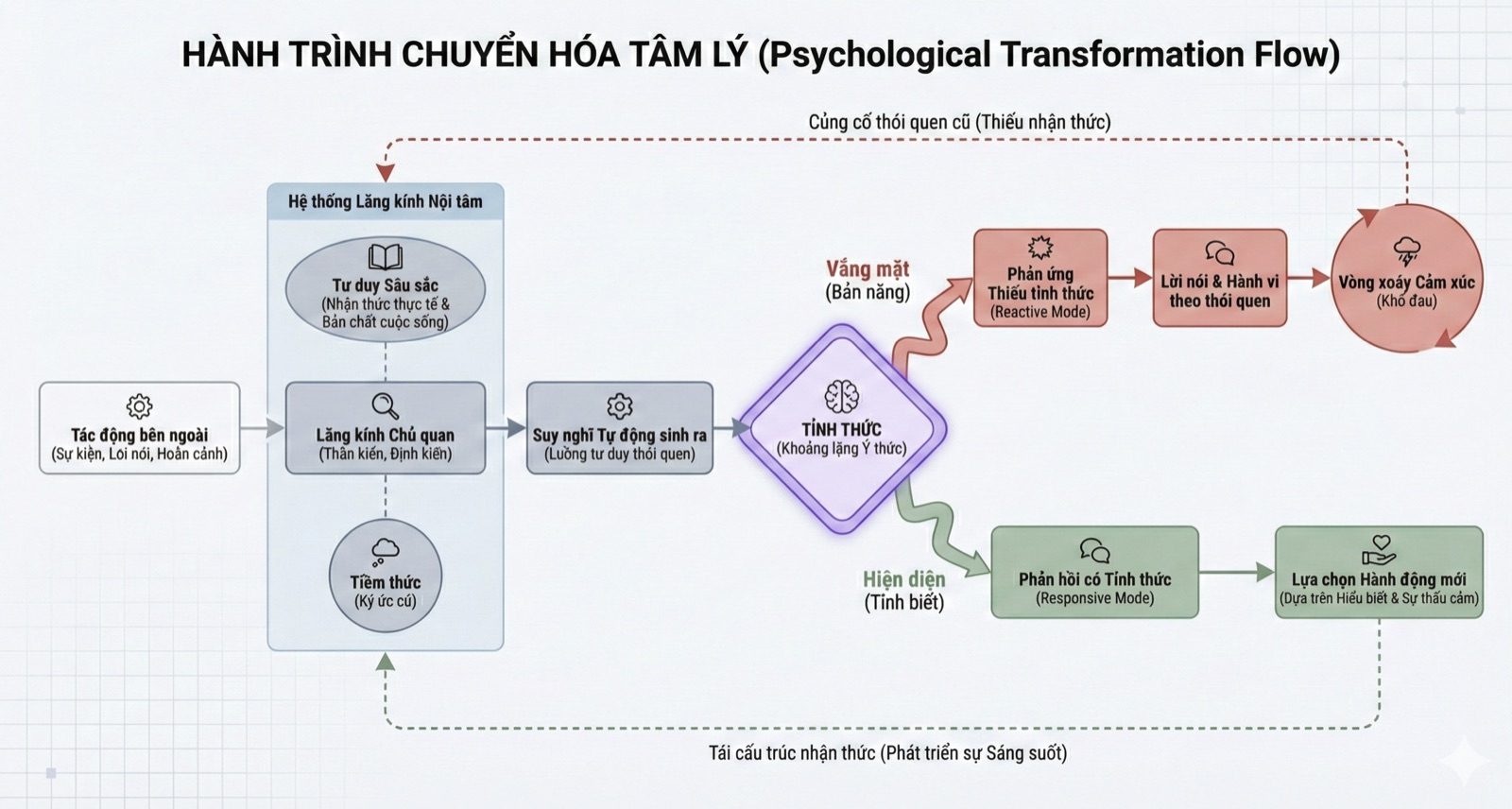
Every day you take in thousands of impacts from the outside: a word from a colleague, a message from a loved one, a status update on social media, an unwelcome event. Each of these triggers an inner chain of reactions — and how that chain unfolds decides whether you fall into an emotional spiral or step into freedom.
The System of the Inner Lens
Before any event can touch you, it must pass through a filtering system:
Deep thought (reflection, faith, core values): This is the layer of foundational belief you have built over many years — how you see yourself, others, and the world.
The subconscious (old memories, unhealed wounds): This is the hidden archive — childhood experiences, patterns repeated from the family, pains never yet acknowledged.
These two layers form the Subjective Lens — the lens through which you see reality. Given the same event, two people with different lenses will see two entirely different realities. Someone betrayed in the past will see a threat where another sees only concern. Someone raised amid criticism will hear reproach where another hears only advice.
From this lens arise Automatic Thoughts — reflexive currents of thinking that need no one's permission, no agreement of yours. They appear so quickly that you often mistake them for the truth, rather than one interpretation of it.
AT THE CROSSROADS: TWO PATHS
By now, the automatic thought has formed. And right at this crossroads, you stand before two paths:
The first path: Absence — Reactive Mode
When Tỉnh Thức is absent, the automatic thought becomes the reaction. No gap, no choice. You are swept into:
Reaction without awareness (Reactive Mode): Flaring up, defending, blaming, withdrawing, or controlling — all of it instantaneous, as though someone pressed a button and your body ran itself.
The worn groove of habitual behaviour: This reaction is nothing new. It is a repeating pattern — the same script you have played out hundreds of times. Each repetition deepens the neural groove, hardens the habit.
The emotional spiral (Vicious Cycle): The reaction produces a consequence. The consequence produces a new event. The new event activates the old lens. The loop closes. This is precisely the mechanism of Nghiệp (the Pattern, karmic momentum) that earlier chapters described — not supernatural punishment, but psychological inertia reinforced with each unconscious repetition.
On this path, the old habit is reinforced. No one is forcing you — it is the very lack of awareness that is programming you.
The second path: Presence — Responsive Mode
When Tỉnh Thức is present, something remarkable happens: a gap appears between the automatic thought and the action. You realise you are having a thought — but you are not that thought. You observe it, rather than being swallowed by it.
Presence (aware knowing): This is not a state of emptiness or non-thinking. It is the state in which you know what you are thinking while you are thinking it — a layer of awareness above the stream of thought.
Response with awareness (Responsive Mode): Instead of reacting automatically, you choose how to respond. The choice may be small — a breath, a silence, a self-questioning — but it changes the whole trajectory.
Choosing a new action: Each time you choose an action different from the old pattern, you are laying down a new neural groove. This is precisely the mechanism of cognitive restructuring — the brain genuinely changes its physical structure when you change how you respond (neuroplasticity).
On this path, awareness is restructured. Clarity grows. And most importantly — you grow.
TỈNH THỨC: NOT A SKILL, BUT A PRINCIPLE
There is a common misunderstanding: many people think Tỉnh Thức (or Chánh Niệm — mindfulness) is a technique, an exercise, something to practise for ten minutes a day. That is not wrong, but it misses the essence.
Tỉnh Thức is not something you do. It is a way you are.
In the full picture of Tử Vi Tâm Thức:
| Concept | Meaning in the system | The role of Tỉnh Thức |
|---|---|---|
| Mệnh (the Given) | Initial conditions — the board you were dealt | Tỉnh Thức helps you see the board as it is, without adding or subtracting |
| Nghiệp (the Pattern) | Behavioural inertia — how you have played so far | Tỉnh Thức helps you recognise the repeating pattern as it unfolds |
| Ý Thức (Awareness) | The power to choose — the next move | Tỉnh Thức is the moment you genuinely choose |
In other words, if Mệnh is the condition and Nghiệp is the inertia, then Tỉnh Thức is the way out — the one point in the whole system where you can intervene.
Why call it a principle and not a skill?
Because it operates across every system:
| System | Without Tỉnh Thức | With Tỉnh Thức |
|---|---|---|
| Bát Tự | You know your Dụng Thần (favourable element) is Water, yet still act from the old Fire | You recognise when you are burning and deliberately cool down |
| Tử Vi | You know Thất Sát is Hãm (in a weakened position), yet still flare up whenever challenged | You catch the moment Thất Sát erupts and choose Courage instead of Anger |
| Thần Số | You know the karmic-debt number 16/7, yet keep repeating the isolation | You notice the urge to withdraw and choose Connection instead of Flight |
| Hawkins | You know you are at level 175 (Pride) yet cannot change it | You catch the moment Pride appears — and let it dissolve |
Without Tỉnh Thức, knowledge is merely information. With Tỉnh Thức, knowledge becomes transformation.
THE MECHANISM: WHY DOES A SINGLE PAUSE HOLD SUCH POWER?
Neuroscience has shown that the pause between stimulus and response is not merely a metaphor — it is a real biological phenomenon.
1. The dual nervous system (Dual Processing)
The brain has two processing systems running in parallel:
| System | Speed | Character | Equivalent |
|---|---|---|---|
| System 1 (Amygdala) | Extremely fast (~12ms) | Automatic, instinctive, no consciousness required | Reactive Mode |
| System 2 (Prefrontal Cortex) | Slower (~500ms) | Analytical, deliberate, intentional | Responsive Mode |
When an event occurs, System 1 always reacts first. That is a survival mechanism. The problem is not System 1 — the problem is when System 1 seizes control and System 2 never gets to speak.
Tỉnh Thức, in essence, is the act of activating System 2 — allowing the prefrontal cortex to take part in the decision rather than letting the amygdala play a solo.
2. Neuroplasticity — the brain changes according to how you use it
Each time you pause instead of reacting automatically, you are:
Weakening the old neural connection (the instinctive reaction pattern)
Creating and reinforcing a new neural connection (the aware response pattern)
This is not philosophy — it is a physical mechanism confirmed by thousands of fMRI studies. The brains of long-term mindfulness practitioners have a thicker prefrontal cortex (better self-regulation) and a smaller amygdala (less dramatic fear responses).
In the language of Tử Vi Tâm Thức: each moment of Tỉnh Thức is one more time you shift frequency from Force to Power. Not by forceful effort, but by simple presence.
3. The principle of the Sacred Pause
Every spiritual and psychotherapeutic tradition points to the same thing:
| Tradition | Name | Essence |
|---|---|---|
| Buddhism | Chánh Niệm (Sati) | Awareness in each moment, without judgment |
| Daoism | Vô Vi (Wu Wei) | Acting from stillness, without forcing |
| ACT psychology | Defusion | Separating the self from the stream of automatic thought |
| DBT psychology | Wise Mind | The meeting point of reason and emotion |
| Stoicism | Dichotomy of Control | Distinguishing what can be controlled from what cannot |
| Viktor Frankl | The Space Between | The gap between stimulus and response |
Six different traditions, six different languages, but all pointing to one single point: the moment you know you are reacting — that very moment has already changed everything. This is not coincidence. It is a principle.
THE IMPACT: WHAT DOES TỈNH THỨC CHANGE?
If you remember only one thing from this entire book, remember this:
You cannot change Mệnh. You cannot erase Nghiệp. But you can change how you respond — and that changes everything.
For the individual: Breaking the loop
Return to the Journey of Transformation diagram: the upper path (Reactive) is a closed loop — emotion produces reaction, reaction produces consequence, consequence triggers new emotion. With no point of intervention, the loop sustains itself indefinitely.
Tỉnh Thức is the one point of intervention. Not because it eliminates emotion — but because it creates the gap in which you can see the emotion without becoming it. The difference between "I am angry" and "I notice I am angry" is a single word, but two entirely different worlds.
For relationships: Cutting the chain reaction
In every relationship, suffering usually comes not from the original event but from the chain reaction: A speaks → B reacts → A reacts back → B escalates → the spiral. It takes only one person in that chain to pause, and the whole chain breaks.
This is not weakness. It is the highest strength — the strength Hawkins calls Power, as opposed to Force.
For karmic momentum: From inertia to a new trajectory
Nghiệp, as said in earlier chapters, is not reward and punishment. Nghiệp is inertia — the tendency to repeat what has become familiar. Each time you react in the old pattern, the inertia is reinforced. Each time you pause and choose otherwise, the inertia is weakened.
Accumulate enough of those moments of choosing otherwise, and the whole trajectory of a life changes. Not by magic — but by neural mechanics and patience.
FORCE vs. POWER: TWO WAYS OF MASTERING EMOTION
This is where most people misunderstand: they think mastering emotion means restraint, suppression, or control. That is exactly Force — and it will fail.
| Criterion | Force — below 200 | Power — above 200 |
|---|---|---|
| How emotion is handled | Suppress, deny, push down | Recognise, allow, let go |
| Energy spent | Enormous (like holding a ball underwater) | Minimal (like opening your hand to let the ball rise) |
| Short-term result | Seems effective | Seems slow |
| Long-term result | Explosion, burnout, or numbness | Ever-deepening peace, ever-widening freedom |
| Inner feeling | I must be stronger than this emotion | This emotion is a part of me, but not all of me |
Tỉnh Thức belongs to the Power column. It does not fight emotion. It looks at emotion. And the very act of looking — honest, non-judging, not trying to fix — naturally reduces the intensity of the emotion. Not because you forced it, but because, once seen, the emotion completes its task and dissolves on its own.
This is exactly what David R. Hawkins calls Letting go — releasing is not an action, but the natural result of awareness.
THE PLACE OF TỈNH THỨC ON THE MAP OF CONSCIOUSNESS
If you place Tỉnh Thức on the Thang Đo Hawkins (Hawkins' map of consciousness), it does not sit at any specific level. It is the mechanism of shifting levels — the staircase between the floors.
| Hawkins level | State | The role of Tỉnh Thức |
|---|---|---|
| 20 – Shame | Wanting to disappear | Tỉnh Thức helps you see: I feel shame ≠ I am a shameful person |
| 75 – Grief | Loss, emptiness | Tỉnh Thức allows grief without being drawn into despair |
| 100 – Fear | Threat, contraction | Tỉnh Thức helps distinguish real danger from fear born of old memory |
| 150 – Anger | An eruption of energy | Tỉnh Thức helps convert the energy of anger into purposeful action |
| 175 – Pride | Defence through the ego | Tỉnh Thức helps you see the ego at work — and step outside it |
| 200 – Courage | The threshold of transformation | Tỉnh Thức begins to stabilise here — you are brave enough to look directly |
| 310 – Willingness | Open to learning | Tỉnh Thức expands — you actively observe rather than passively endure |
| 400 – Reason | Clear analysis | Tỉnh Thức joins with intellect — seeing both the pattern and its root cause |
| 500 – Love | Unconditional love | Tỉnh Thức becomes a natural state — no longer requiring effort |
| 600 – Peace | Deep stillness | Tỉnh Thức and being merge into one — no observer remains |
You do not need to reach level 600 for Tỉnh Thức to be of value. A single moment of awareness at level 150 (Anger) is enough to stop an argument from escalating. A single moment of awareness at level 100 (Fear) can save you from a reflexive, mistaken decision.
The value of Tỉnh Thức lies not at the summit — but in every moment you remember to use it.
CLOSING: FROM UNDERSTANDING TO EXPERIENCE
This entire part does only one thing: it shows that Tỉnh Thức is the meeting point where knowledge meets transformation. Mệnh gives you the board. Nghiệp gives you the habit of play. But only Tỉnh Thức gives you the power to pause, see, and choose a new move.
You can finish this part and nod in agreement. That is understanding. But understanding does not change a life — experience changes a life. Knowledge of mindfulness in a book is never equal to one moment in which you truly pause in the middle of anger and see yourself being angry.
If this resonates with you — do not stop here. Go deeper. Mindfulness is a vast field with thousands of years of tradition and decades of modern scientific research. This book does not teach the practice — but it wants you to know that the practice exists, and it works.
The rest — is your own journey.