The map of the Golden Triangle
Having distinguished the two ways of seeing destiny and gone deep into the three layers — Mệnh (the Given), Nghiệp (the Pattern), Ý Thức (Awareness) — we need an overall map to see how they interact in reality.
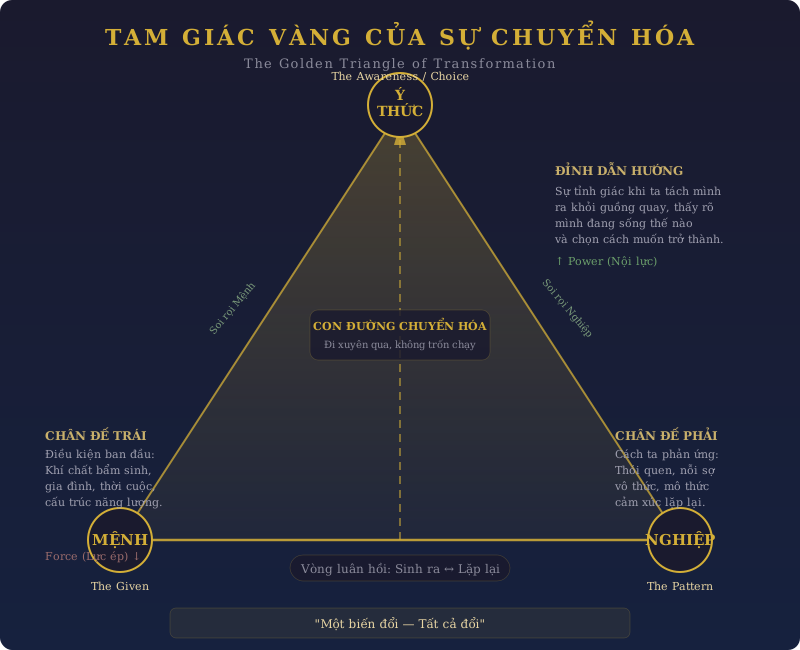
That map is the Tam Giác Vàng (the Golden Triangle) of Transformation.
These are not three separate points, but a Dynamic Balancing System. Your life is the very space that unfolds within this triangle.
1. The two footings: the weight of reality
Bottom left — MỆNH (The Given):
All the initial conditions we carry as we step into life: innate temperament, family, the times, and the energetic structure within the chart.
This is the terrain of the river — where the story begins.
Bottom right — NGHIỆP (The Pattern):
The way we have reacted, and go on reacting, to those conditions: habits, unconscious fears, repeating emotional patterns.
This is the way of rowing out of old habit — skilful or clumsy, clear-sighted or blind.
These two points form a base that is steady but also heavy with weight. Without the third vertex, a person will forever pace back and forth along this base: being born (Mệnh) $\leftrightarrow$ repeating habit (Nghiệp). That is the weary wheel of rebirth.
2. The guiding apex: the escape into freedom
The apex — Ý THỨC (The Awareness/Choice):
The awareness that blazes up when we step out of the grind, see clearly how we are living, and choose the way we want to become.
Not an impulsive wish (Force), but an inner direction (Power) — a choice full of clear insight.
Ý Thức is precisely the point of intervention: where inertia stops, and a new timeline opens.
3. The vertical axis: the path of transformation
The dashed line down the middle of the triangle is the journey of the practitioner of Tử Vi Tâm Thức.
This path does not deny Mệnh, nor does it flee Nghiệp. It passes through them, but in an upward direction.
When Ý Thức shines into Nghiệp, an unconscious flash of anger is halted. We learn the lesson of composure.
When Ý Thức shines into Mệnh, a difficult circumstance (a star in a weak position) is no longer misfortune. It becomes fuel to burn away the feeble ego.
4. The principle of mutual influence
This triangle has never stood still. It turns with every breath, with your every smallest decision throughout the day.
Its operating law is “Change one, and all change”:
Ý Thức grows stronger (Awareness $\uparrow$):
The force of Nghiệp automatically weakens (for habit fears the light of awakening). Mệnh is regarded with greater compassion.
Nghiệp is transformed (Pattern breaks):
Mệnh becomes “easier to breathe,” and the knots in the chart untie of themselves. The released energy makes Ý Thức all the clearer.
Mệnh is accepted (Acceptance):
We no longer spend energy fighting circumstance. That resource flows back to Ý Thức, to create the new.
Conclusion:
The Golden Triangle is not merely a theoretical diagram. It is a formula for living.
Every method of diagnosis and treatment in this book (Bát Tự — Four Pillars, Tử Vi — Purple Star astrology, the Hawkins scale) serves a single purpose: to help you move from the heavy base upward toward the high apex of awakening.
Decoding the Golden Triangle
To truly grasp the interaction between Mệnh, Nghiệp, and Ý Thức, let us use the most familiar of metaphors: a card game.
1. MỆNH — THE HAND DEALT
Keywords: Acceptance & Understanding.
At the Mệnh vertex, the chart is no longer a verdict, but the very hand you were dealt on stepping up to the table of life. In a card game, the law of chance deals each person a different hand:
Some hold four of a kind, a royal flush (a chart full of Cát Tinh — auspicious stars — a powerful family, innate intelligence).
Some hold odd cards, junk, a poor hand (a chart full of Sát Tinh — malefic stars — a hard childhood, a bodily defect).
But the golden rule is: you are not allowed to swap your hand. You cannot return your chart to Heaven and demand a redeal. The difference of the awakened person lies here: instead of complaining “Why is my hand so bad?” (the victim’s psychology), they focus on:
Reading the hand they hold carefully (decoding the chart).
Recognising which card is the trump (Dụng Thần, the favourable element) and which is the junk to discard (Kỵ Thần, the unfavourable element).
Asking themselves: “With this hand, what is the subtlest move?”
Mệnh is the raw material. And a skilful player can use middling cards to beat someone who holds a fine hand but does not know how to play.
2. NGHIỆP — THE CURRENT GAMEPLAY
Keywords: Habit & Skill.
If Mệnh is the cards, then Nghiệp is your level and style of play. This is where most people fail, because they play by unconscious habit (auto-pilot).
Two people may hold the same poor hand (difficult circumstances), yet their way of playing creates two destinies:
Player A (Nghiệp accumulating — low frequency): sees a bad hand and panics, plays recklessly, turns bitter, blames the dealer. Result: loses everything.
Player B (Nghiệp dissolving — high frequency): sees a bad hand and stays calm, keeps the rhythm, “holds back” to await the moment, knows when to be firm and when to yield. Result: limits the losses, and even turns the game around at the last minute.
In Hawkins’ language:
Nghiệp at the level of Fear, Anger (Force): we turn the hand into a burden.
Nghiệp at the level of Courage, Acceptance (Power): we turn the hand into a challenge that sharpens our mettle.
Nghiệp is precisely the dynamic variable. You may have played the last round badly, but you can entirely change your strategy in this one.
3. Ý THỨC — THE MASTER PLAYER
Keywords: Decision & Rebirth.
The third vertex — Ý Thức — is where the game truly changes in quality. Ý Thức is not the craving to win or lose (that is still the ambition of Nghiệp). Ý Thức is the presence of “the Observer” standing behind the hand of cards.
Ý Thức is the moment you realise: “I am not the hand (Mệnh), nor am I this worn-out style of play (Nghiệp). I am the one who decides what kind of player I will become.”
A typical example: a person whose Mệnh is prone to addiction (a chart with Tham Lang in a weak position, Đào Hoa meeting a malefic). The old Nghiệp has repeated for years: dissipation, escaping pressure through intoxicants.
The moment of Ý Thức: when they hit bottom and wake. A cold, sharp seeing arises: “If I keep playing like this, I’ll lose everything.”
The new action: They do not pray for a better hand. They choose to change the environment (change tables), to seek a teacher of the way (find a coach), to break the addiction (fix the technical flaw).
When Ý Thức is strong enough, it creates a new gravitational pull:
It draws Mệnh into a more mature perspective (reading the chart to correct oneself, not to predict wealth or poverty).
It reshapes Nghiệp into new, more positive loops.
At this point, the card game of life turns from a game of chance into the art of Self-Mastery.